Web 1.0
Web 1.0 is a rather monotonic and dull environment which Email is virtually the only means for surfers to contact with webmaster in your web browser. Information is transferred in one direction, quite similar to traditional television broadcasting. Recall the "golden ages" when personal websites are thriving. You may use free spaces to make your website:Lists of free spaces for personal websites
Geocities.com (obsolete since 2009)Xoom.com (now obsolete, see an archieve of search result containing Xoom personal webpage in 23 February 1999)
What accounts for Web 1.0's demise?
See reasons for Web 2.0's succeeding (PDF file, get Adobe PDF reader).Updating in Web 1.0 is complicated. Remember those days? You must know many techniques editing webpage so as to make it beautiful, and you should buy a good software like Dreamweaver and Cute FTP to have a better results. You then went to computer schools to learn about these techniques. Without money? You use notebook (.txt) to edit HTML codes of your website, which make you easily to fall asleep or get stucked.
Even you have the software, broadband was not common in early 2000s. Uploading speed was slow and posed obstacles in maintaining your personal website. Disconnection was a great problem.
Contact with others about your / their sites. That's ok. You could do so by ICQ or email. However, they were not incorporated into web browser: less convenient.
Web 2.0
Seems that Web 2.0 is reaching its zenith nowadays. Web 2.0 can be summarized by a word: interactions. Two-way interactions.Web 2.0 did not start recently. Nor it started with the invention of Facebook.
See this flashboard page (of HKflash site). It was introduced in year 2000 in Hong Kong. It is nearly obsolete now, but on those days, it was advanced that different users could chat each other and webmasters could draw pictures and make reply instantly. Chatrooms and forums (discussion groups) also thrived in early 2000s. Users can also post text comments instantly. However, nearly all functions of flashboards, chatrooms and forums can be found in Facebook, found in 2004. So Facebook becomes common communication and posting device.
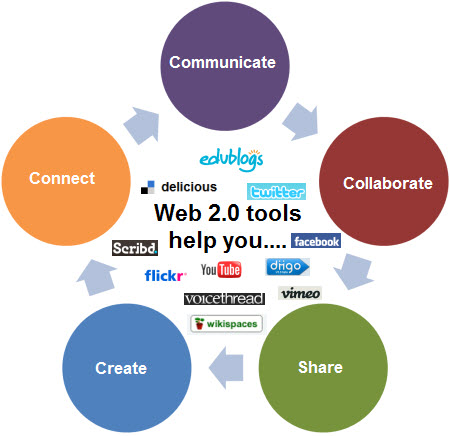
Interaction without dead-end (Retrieved from http://www.theedublogger.com/)
Blogs is also commonly used by users especially from 2005 to 2010, which have various advantages over personal webpages. Users can choose the design of blog easily without knowledge of HTML. After 2010, thanks to development of mobile internet technology, micro-blogs have become more popular.
Lists of blogging website:
Xanga (obsolete in 2013)Blogger
Wordpress
Twitter (micro-blogging)
Sino Weibo (Chinese micro-blogging)
Examples of discussion platform:
Myspace (popular in United states)Topix (discussion forum, popular in United states)
Quora (Q & A website)
In contrast to Web 1.0 encyclopedia (e.g. Encyclopedia Britannica), users are allowed to edit relatively freely under Web 2.0 conditions like wiki. Though less like to be peer-reviewed, Web 2.0 encyclopedias allow more user participation and broader topics that are unlikely covered by professionals of academics and official entities. Also, creative commons are often allowed to be promoted under discretion of photo / video providers.( see creative common stance of a
site, labelled
 )
)Examples of web-based encyclopedia:
WikipediaBaidu (Chinese version of web-based encyclopedia)
Wikia

沒有留言:
張貼留言