2014年12月27日 星期六

Critical Review 3: Discussing about public libraries in the future

Source of the article


Ministerial Advisory Council on Public Libraries (2012) Tomorrow's Library: Discussion Paper. State Government of Victoria. Retrieved from Public Libraries Victoria Network website: http://www.plvn.net.au/sites/default/files/TLTD002_Tomorrow's Library Discussion Paper final web.pdf


Introduction


As information technology advances from web 1.0 to 2.0, library role evolves, Victorian public libraries’ functions and services are evaluated by Australian government (Ministerial Advisory Council on Public Libraries), providing strategic guidelines for future development. Several aspects are targeted for evaluation: collection, resources and programs, library buildings, technology and service delivery. Different stakeholders are consulted about social, economic, cultural and local factors affecting library service developments. Goals include promoting information literacy, securing freedom of information among community, and enhancing community connection and participation though library usage.


Important issues


Collections, resources and programs

Internet usage results in a decline in borrow figure of hard-copy collection. Consequently, less people visit libraries as the majority of people visit library because of book-borrowing. The decreasing trend of book-borrowers, combined with budget concern, result in rarely used, obsolete books remaining on shelf. Other challenges include large variety of format of library materials desired by community, particularly electronic resources and databases; lack of standards adopted by libraries in collection development; dependence of librarians relying on book companies’ recommendations to buy collections instead of producing wish-list of collections by libraries or users; increasing community expectation of free library programs’ varieties; consideration of extension of library service for remote areas; security concerns for RFID tracking user’s usage of materials. Various assistances should be provided to solve the above challenges.

Library buildings

Community’s desires for library construction have been changed as Web 2.0 has become a trend. More flexible and adaptable structure is preferred. Flexible buildings serve for different purposes, some even unrelated to Web 2.0 development, like emergency shelters. Community service unit like medical and childcare service are included in libraries for users’ convenience. As maximizing budget and revenue are factors of concern, buildings fit of purpose and complying with standards are new trends. Demands of library users like green buildings are also incorporated.

Technology

In past decades, technology has evolved quickly from Web 1.0 to 2.0 with the help of blogs (Greenland, 2013, p.219). Library internet area is provided, particularly for less privileged library users. As electronic and other types of resources are thriving, libraries join to form a co-operated network, which increase transportation costs. In the future, challenges will be related to development of Web 3.0, which new technology should be provided in libraries for users to utilize: Although libraries provide desktop computers, recent trend is assessing collections and information through tablet or mobile phone. Broadband network speed and stability is critical for efficiency. Furthermore, apps design is challenging that affects users' impressions about libraries.

Service delivery

Staffs and users are aging, resulting in lower chance to adapt for rapidly changing digital environment, and susceptible for retirement in near future. The positive side is younger, competent staffs can fill vacancies and the re-structuring of library staff can provide flexibility for library to allocate resources (Burke, 2013, p.212). Aging groups of users often need new service like word magnifier and voice reading machines to assist their usage of materials. Due to immigrants and diversity of population, models of services vary from one library to another, posing difficulties in balancing equality and cost-recovery when providing service. Resources are to be allocated for locating and assisting remote citizens and counseling non-users about library service.


Shortcomings


Although numerical figures assist discussions, not much is mentioned about respondents’ verbal response. It is unknown whether interviews and focus groups are carried out. As users’ feelings are factor for the decision whether they use library services, comments should be included. Also, assessment focus on Victoria State only, and the situation of libraries in other states or countries may be different from the article mentioned. For instance, personal notebooks and i-pads are not very common in developing states, raising questions whether digital devices should also be lent to library users - controversial as security concerns may also be considered. When considering cost-returning and efficiency, it poses dilemma that library users have different opinions about charging library services and whether advanced services that are not popular should be provided.


Conclusion


Libraries should notice trends in technology development and users’ needs, utilizing Web 2.0 like blogs (NCTE/IRA, 2008) and Facebook (Burke, 2013, p.133) and provide appropriate digital environment. Shortcoming should be amended so that library services remain relevant (University of Brighton, 2008): library digital environments vary for different places, so local conditions should be taken into considerations. Australia's phenomenon should be noticed and should not taken be granted for other places. Assess of the situation should be done continuously and more stakeholders should be invited to express their opinions in words, recordings and other formats.

Critical Review 2: Technology and health information systems

Source of the article


Lewis, D., Hodge, N., Gamage, D & Whittaker, M. (2011) Understanding the role of technology in health information systems. Retrieved from the University of Queensland Health Information Systems Knowledge Hub: http://www.uq.edu.au/hishub/wp17


Introduction


Information-communication technology (ICT) plays a major role to improve isolated developing countries’ health system in aspects includes: communication and data-sharing between different health centres (close to Web 2.0), supporting health workers, providing visual tool to locate disease-outbreak regions, storing (close to Web 1.0) and interpreting medical data in databases. Medical ICT projects were introduced in Pacific region, as medical care system became a concern and projects aimed at improving health service qualities in the region. Some projects were successful but the others failed for various region. The article discussed about opportunities and benefits of introducing ICT for medical care system and evaluated the effectiveness of ICT medical projects, giving reasons for success or failure of projects.


Important issues


"ICT always improves health system" was  assumed, but flawed, as one-directional information received by medical entity is not enough for decision making: no feedback mechanism from clients and other medical institutions, making it difficult for isolated managers to decide critical factors like effectiveness, cost, social and ethics before enacting medical programs. Four questions were arisen:


Opportunities and gains ICT potentially pave for health system


With ICT, patients’ health conditions were recorded in databases, which were assessed by public institutions. Also, records can be retrieved by private clinics upon patients’ agreements. Therefore, patients’ health history could be tracked down and diseases are traced out easily. Without physical records, patients’ data were transferred electronically through large distance with little time and transportation cost. PDAs allowed data to be assessed in remote directions, which increased efficiency especially in cases of disease outbreak. Multimedia were used for video-conferencing of medical professionals, reducing transportation cost.

Outcomes of medical ICT projects


Similar to other ICT projects in developing world, about half of medical service ICT projects failed due to information sensitive nature, which both people, process and technology are critical (as cited in Steinmuller 2001, Cleverley 2009, UNAPCICT 2010). Resources were mismatched such as insufficient senior management; clients were unmotivated such as lack of will to learn about how to use electronic medical systems. Non-standardized system led to difficulties to handle and possible break down due to network and electrical problems, forcing staffs and patients to switch back to paper work and other traditional methods. Open standard of ICT system may relieve the problem (Saldanha & Krishnan, 2012, p. 308).
Common medical communication language was difficult to be set as different dialects were spoken for different communities in Pacific countries. Standardization was hindered by dispersed population. In contrast, communication language was standardized for library communication.


Tools, models and frameworks for evaluation of health system.


Case studies of Uganda and Solomon and Marshall Islands were used for evaluation, using 12 factors judging degree of success of ICT implementation. Seven stages of health information system was introduced as framework for future ICT development.


Shortcomings


The article discussed about ICT in Pacific region, consisting of various isolated island countries, located at tropical areas. As challenges of hygiene conditions vary inside Pacific countries, more researches have to be done to conclude about ICT situation. Furthermore, the experience may not be useful in large countries with plenty of manpower and intense transportation network, e.g. China and Australia, or densely populated region, e.g. Sydney and Hong Kong (IETHK, 2014), or information literate developed region with sufficient capital sustaining advancing medical system.

Conclusion


Although Pacific region consists of middle-low or low income countries, mobile phones have been thriving, overcoming infrastructure inferiority. However, monopoly resulted in high communication cost, hindering Web 2.0 application in medical data sharing.
Though article focused on medical service, library services are also information sensitive (ALA, 2004). Fallacy of medial ICT projects should be noticed so that library information programs are less likely to waste budgets or subsidies. 12-point framework and 7-step stages in developing medical ICT should be taken as reference when libraries develop ICT projects. Librarians should not focus only on technology development but neglect human and cultural factors.


Critical Review 1: Assessing the ease of Web 2.0 adoption by organizations

Source of the article


Saldanha, T.J.V & Krishnan, M.S. (2012). Organizational adoption of Web 2.0 technologies: An empirical analysis, Journal of Organizational Computing and Electronic Commerce, 22 (4), 301-333. Retrieved from CSU library database.


Introduction


Business enterprises’ adoption of Web 2.0 technologies was discussed as internet usage has become popular among consumers. Factors of organizational Web 2.0 usage were investigated by quantitative method: surveys testing hypotheses. Results were analyzed by statistical methods to find Web 2.0 usage is either positively or not correlated with factors investigated: openness of standards of working inside companies; intensity of knowledge used when business is carried out; company size; and the intensity of industries’ competitive environment.


Important issues


Quantitative research methodology was used: author first reviewed literature introducing Web 2.0. Then, four hypotheses were proposed; quantitative data of business firms’ response were collected, computed with statistical methods like chi-test and tabulated. Hypotheses (H1 to H4) and testing results are shown:

H1 tested for whether open standards of organization are adopted in greater extent result in more usage in Web 2.0 technologies. The result shows the condition of H1 is highly correlated to the results, meaning that when companies’ interface allow employees accessing information technology more easily, Web 2.0 is more used by employees for practicing work. For example, when companies that do not filter software to ban employees from assessing social media sites and open-sources like pdf, employees without consequences, are less refrained from using Web 2.0.

H2 tested for whether larger sized companies allow more Web 2.0 application. The result shows the condition of H2 is correlated to the results: Web 2.0 technologies are more favorable in large firms’ environment. The finding is reasonable due to economies of scale (Hutter et. al, 2013 ,p.19): larger firms have more resources to provide accessories facilitating Web 2.0 usage in companies. For example, larger firms have relatively low cost in mass-purchasing of web-hosting spaces for intranet, internet service packages, social networking sites and services educating employees (Burke, 2013, p.42). In contrast, it is less probable for smaller firms to get discounted services, thus require employees to pay themselves to  purchase or learn about Web 2.0.

H3 tested for whether business-usages of Web 2.0 increase with knowledge intensity. The result shows the condition of H2 is moderately correlated to the results, meaning that Web 2.0 usages increase with knowledge intensity. It is reasonable as professionals are more adapted in assessing and evaluating information while non-professionals’ (e.g. manufacturing) works tend to be under instructions, with less demand of interactive tools to exchange information.

H4 tested for relationship between fierceness of firms’ competition with Web 2.0 development. As p factor is larger, no appreciable correlation was found. Explanations include: firm types have different effects - encourage, discourage or do not affect employee usage of Web 2.0. When benefits of technology development overcome time consumed which can be used for production otherwise, companies have interest to promote Web 2.0. On the other hand, some competitions involve price competition only, without involving necessity of information interactions. Web 2.0 merely adds extra time and money cost, reducing productivity.


Shortcomings


Although statistical method is objective, testing hypotheses reliably, it is difficult for ordinary readers to recognize the implications given in numerical analysis, such as standard deviation and p-value. Qualitative methods, which is absent in the article, should be employed so as to find out opinions of companies about Web 2.0. Interviews should be carried out and dialogues should be recorded, so that experiences of companies in practice dealing with digital environments are mentioned, giving a clearer picture about each hypothesis. Extensive literature reviews may provide plenty of background information, but the literature cited, written in between 2007 to 2011,  is easily to become obsolete and is less suitable to explain the most recent situation. For example, recent development of digital environment related to Web 2.0 and 3.0 are not included in the article, so companies’ recent response facing newest trend may change so fast that deviate from finding of previous document. As earliest age of Web 2.0 is different from recent Web 2.0 or even web 3.0, the reaction of companies towards them can, in the worst case, be the opposite. It is arguable that for the rapidly changing topic of digital environment, online research produced recently may be of more value for librarians to plan for future library development.
Furthermore, firm “size” may be sometimes irrelevant when smaller firms cooperate together in some matters, and large firms like governments are separated into various small departments probably with minimal inter-departmental cooperation. Research of each firms’ detailed structure must be done so that flaws of H2 can be eliminated.
Further hypotheses completing investigation include: First, large number of companies’ stockholders has positive impacts on Web 2.0 development, for example solely owned companies encourage Web 2.0 in less extent than partnership and listed company; government and large listed company mostly encourage on-job Web 2.0. Second, companies in freer / developed society put more effort on Web 2.0 development. This involves cross-country investigation, which is absent in the article. Inter-countries Web 2.0 cooperation of libraries require the understanding of that relation. Third, open standards,  promoted by government regulations (Ghosh, 2011, p. 21), enhances Web 2.0 usage.

Conclusion


Factors affecting companies’ Web 2.0 utilization were investigated with 4 proposed hypotheses. Open standards, large size and information-intensive nature favors Web 2.0 development, while company competition status has ambiguous effect on Web 2.0. More hypotheses and interviews should be done (as mixed research method) to cross-check the validity of article’s conclusions.

What's next

Now you should have some basic impression about Web 1.0 to Web 3.0 development. To librarians' concern, 3 articles about digital environment about usage of digital technology in different environments like workplace, in professional aspects and in the future will be introduced and criticized.

Warning: some of the links above contain potentially non-peer-reviewed materials. Take it for reference only and compare with other sources!

Think again

In Interstellar(2014), five dimensional organisms can easily control three dimensions, but not the reverse. Don't you think that when we advance from Web 1.0 environment to Web 3.0 environment, we have more "degrees of freedom", which are difficult to imagine in Web 1.0 environment?

Evolution of Web 1.0 to 3.0 ... and beyond

Get some ideas of Web 3.0?

Get more ideas about Web 3.0?


In Web 3.0, the intelligence of computer allows moderation of content of information between consumers and / or producers so as to make communication software more user-friendly, suiting users' appetite. Gone are the days when advertisements that are odd to some users appear on their screen. Instead, computer recognize users' interest and give them more pleasant feelings when retrieving information. Users can also change the interface and other preferences. Web 3.0 effectively solve the problem of over-feeding of information of Web 2.0 (similar to advertisements in Television age, perhaps!).

In summary, here are the possible comparison between Web 1.0, 2.0 and 3.0:

Web 1.0

Webmaster (producer)
Consumer
Community
Interaction
User-friendly
(Inadequate) information : starvation

Web 2.0

Webmaster (producer + consumer)
Consumer (+ producer)
Community
Interaction
User-friendly
(Too much) information : fatigue

Web 3.0

Webmaster (producer + consumer)
Consumer (+ producer + master)
Community
Interaction
User-friendly
(Just enough) information : pleasant

Beyond 3.0...

Feel free to express your opinion in CSU forum and also by the old way.

2014年12月26日 星期五

Evolution of Web 1.0 to 3.0 -- visually

I have found a video in Youtube demonstrating evolution of information technology from Web 1.0 to Web 3.0. Although Web 3.0 is less discussed in course material, it is interesting and worthwhile to notice the trend, as we may have soon to be prepared to face Web 3.0 and even Web 4.0 (?) in library environment.


Web 1.0

Web 1.0 is a rather monotonic and dull environment which Email is virtually the only means for surfers to contact with webmaster in your web browser. Information is transferred in one direction, quite similar to traditional television broadcasting. Recall the "golden ages" when personal websites are thriving. You may use free spaces to make your website:

Lists of free spaces for personal websites

Geocities.com (obsolete since 2009)
Xoom.com (now obsolete, see an archieve of search result containing Xoom personal webpage in 23 February 1999)

What accounts for Web 1.0's demise?

See reasons for Web 2.0's succeeding (PDF file, get Adobe PDF reader).

Updating in Web 1.0 is complicated. Remember those days? You must know many techniques editing webpage so as to make it beautiful, and you should buy a good software like Dreamweaver and Cute FTP to have a better results. You then went to computer schools to learn about these techniques. Without money? You use notebook (.txt) to edit HTML codes of your website, which make you easily to fall asleep or get stucked.

Even you have the software, broadband was not common in early 2000s. Uploading speed was slow and posed obstacles in maintaining your personal website. Disconnection was a great problem.

Contact with others about your / their sites. That's ok. You could do so by ICQ or email. However, they were not incorporated into web browser: less convenient.

Web 2.0

Seems that Web 2.0 is reaching its zenith nowadays. Web 2.0 can be summarized by a word: interactions. Two-way interactions.

Web 2.0 did not start recently. Nor it started with the invention of Facebook.

See this flashboard page (of HKflash site). It was introduced in year 2000 in Hong Kong. It is nearly obsolete now, but on those days, it was advanced that different users could chat each other and webmasters could draw pictures and make reply instantly. Chatrooms and forums (discussion groups) also thrived in early 2000s. Users can also post text comments instantly. However, nearly all functions of flashboards, chatrooms and forums can be found in Facebook, found in 2004. So Facebook becomes common communication and posting device.

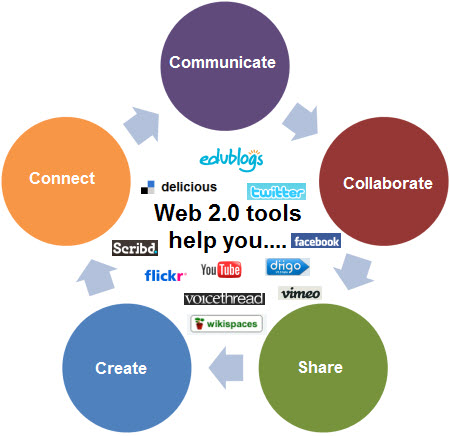
Interaction without dead-end (Retrieved from http://www.theedublogger.com/)


Blogs is also commonly used by users especially from 2005 to 2010, which have various advantages over personal webpages. Users can choose the design of blog easily without knowledge of HTML. After 2010, thanks to development of mobile internet technology, micro-blogs have become more popular.

Lists of blogging website:

Xanga (obsolete in 2013)
Blogger
Wordpress
Twitter (micro-blogging)
Sino Weibo (Chinese micro-blogging)

Examples of discussion platform:

 Myspace (popular in United states)
Topix (discussion forum, popular in United states)
 Facebook
 Quora (Q & A website)

In contrast to Web 1.0 encyclopedia (e.g. Encyclopedia Britannica), users are allowed to edit relatively freely under Web 2.0 conditions like wiki. Though less like to be peer-reviewed, Web 2.0 encyclopedias allow more user participation and broader topics that are unlikely covered by professionals of academics and official entities. Also, creative commons are often allowed to be promoted under discretion of photo / video providers.( see creative common stance of a 
site, labelledhttps://licensebuttons.net/l/by-sa/3.0/88x31.png)

Examples of web-based encyclopedia:

Wikipedia
Baidu (Chinese version of web-based encyclopedia)
Wikia

 Web 3.0

 We have not finished Web 2.0. Why not discussing web 3.0 in next time?

2014年11月14日 星期五

Hi all!

My name is Rex, and I am glad to study "The Digital Environment" course. I hope to acquire more ICT knowledge and inspiration throughout these months.